
ITR Filing for AY 2026–27 Begins: ITR-1 & ITR-4 Now Available
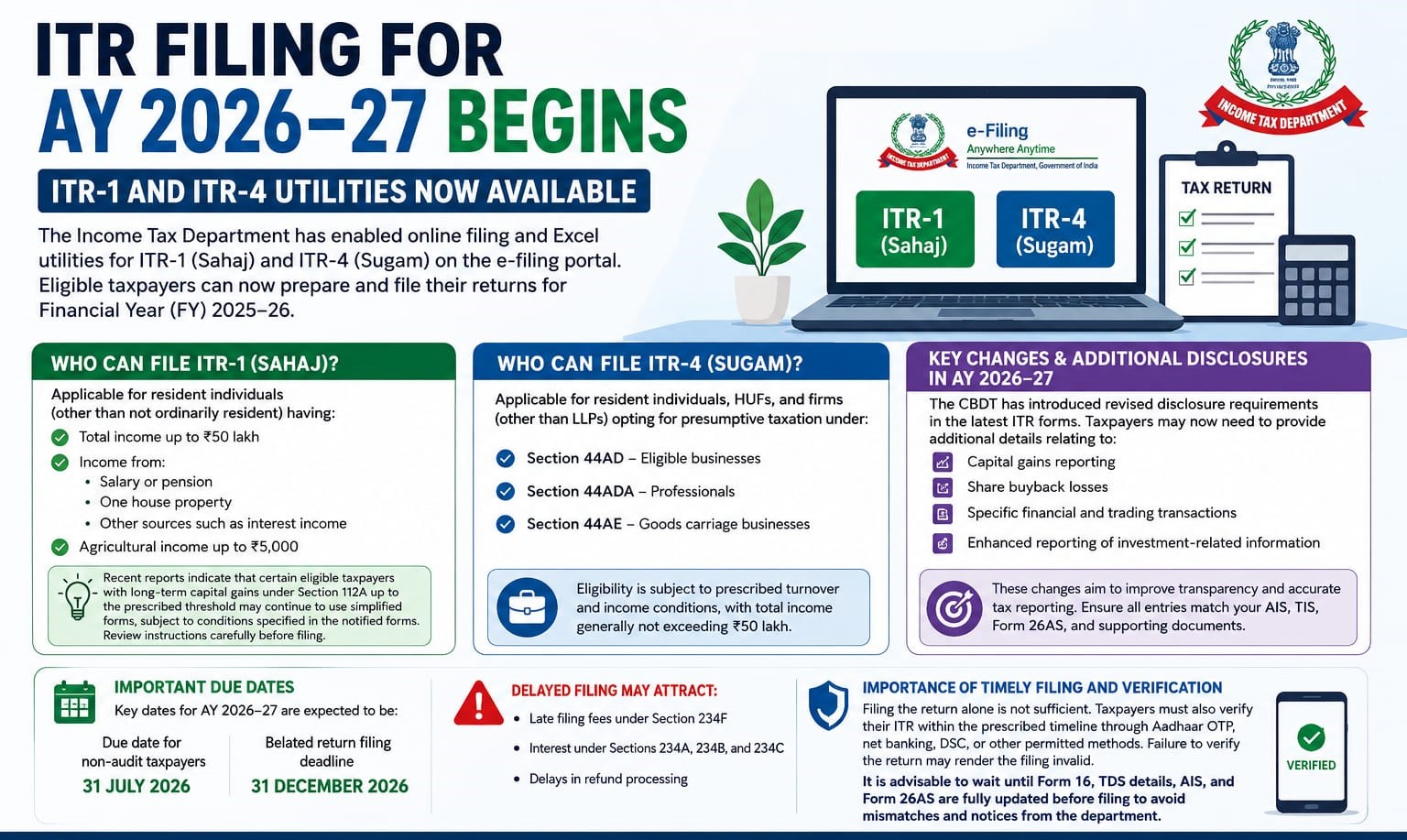
ITR Filing for AY 2026–27 Begins: ITR-1 and ITR-4 Utilities Now Available
The Income Tax Department has officially started the Income Tax Return (ITR) filing season for Assessment Year (AY) 2026–27 by enabling online filing and Excel utilities for ITR-1 (Sahaj) and ITR-4 (Sugam) on the e-filing portal. As per the latest portal update released on 15 May 2026, eligible taxpayers can now begin preparing and filing their returns for Financial Year (FY) 2025–26.
Who Can File ITR-1 (Sahaj)?
ITR-1 is applicable for resident individuals (other than not ordinarily resident) having:
- Total income up to ₹50 lakh
- Income from:
- Salary or pension
- One house property
- Other sources such as interest income
- Agricultural income up to ₹5,000
Recent reports also indicate that certain eligible taxpayers with long-term capital gains under Section 112A up to the prescribed threshold may continue to use simplified forms, subject to conditions specified in the notified forms. Taxpayers should carefully review the instructions before filing.
Who Can File ITR-4 (Sugam)?
ITR-4 is meant for resident individuals, HUFs, and firms (other than LLPs) opting for presumptive taxation under:
- Section 44AD – Eligible businesses
- Section 44ADA – Professionals
- Section 44AE – Goods carriage businesses
Eligibility is subject to prescribed turnover and income conditions, with total income generally not exceeding ₹50 lakh.
Key Changes and Additional Disclosures in AY 2026–27
The CBDT has introduced revised disclosure requirements in the latest ITR forms. Taxpayers may now need to provide additional details relating to:
- Capital gains reporting
- Share buyback losses
- Specific financial and trading transactions
- Enhanced reporting of investment-related information
These changes aim to improve transparency and accurate tax reporting. Taxpayers should ensure that all entries match their AIS, TIS, Form 26AS, and supporting documents before submission.
Important Due Dates
Key dates for AY 2026–27 are expected to be:
- Due date for non-audit taxpayers: 31 July 2026
- Belated return filing deadline: 31 December 2026
Delayed filing may attract:
- Late filing fees under Section 234F
- Interest under Sections 234A, 234B, and 234C
- Delays in refund processing
Importance of Timely Filing and Verification
Filing the return alone is not sufficient. Taxpayers must also verify their ITR within the prescribed timeline through Aadhaar OTP, net banking, DSC, or other permitted methods. Failure to verify the return may render the filing invalid.
It is also advisable to wait until Form 16, TDS details, AIS, and Form 26AS are fully updated before filing to avoid mismatches and notices from the department.
Conclusion
With the Income Tax Department enabling ITR-1 and ITR-4 filing utilities early for AY 2026–27, salaried individuals, pensioners, freelancers, and small business owners can begin preparing their returns well in advance. Reviewing eligibility, reconciling tax documents, and filing accurately within due dates can help taxpayers avoid notices, penalties, and delays in refunds.
For expert guidance on this topic, contact your tax professional today.
Have Questions? We're Here to Help
Get expert advice from SUJEET SANGAM & CO.. Reach out to discuss your requirements.